GUOSHI ADVANCED MATERIALS
Ceramic parts
for industrial furnaces
Radiant tubes, riser tubes, protection tubes, burner tubes and refractory materials for industrial furnaces, made in Zibo, Shandong, China.
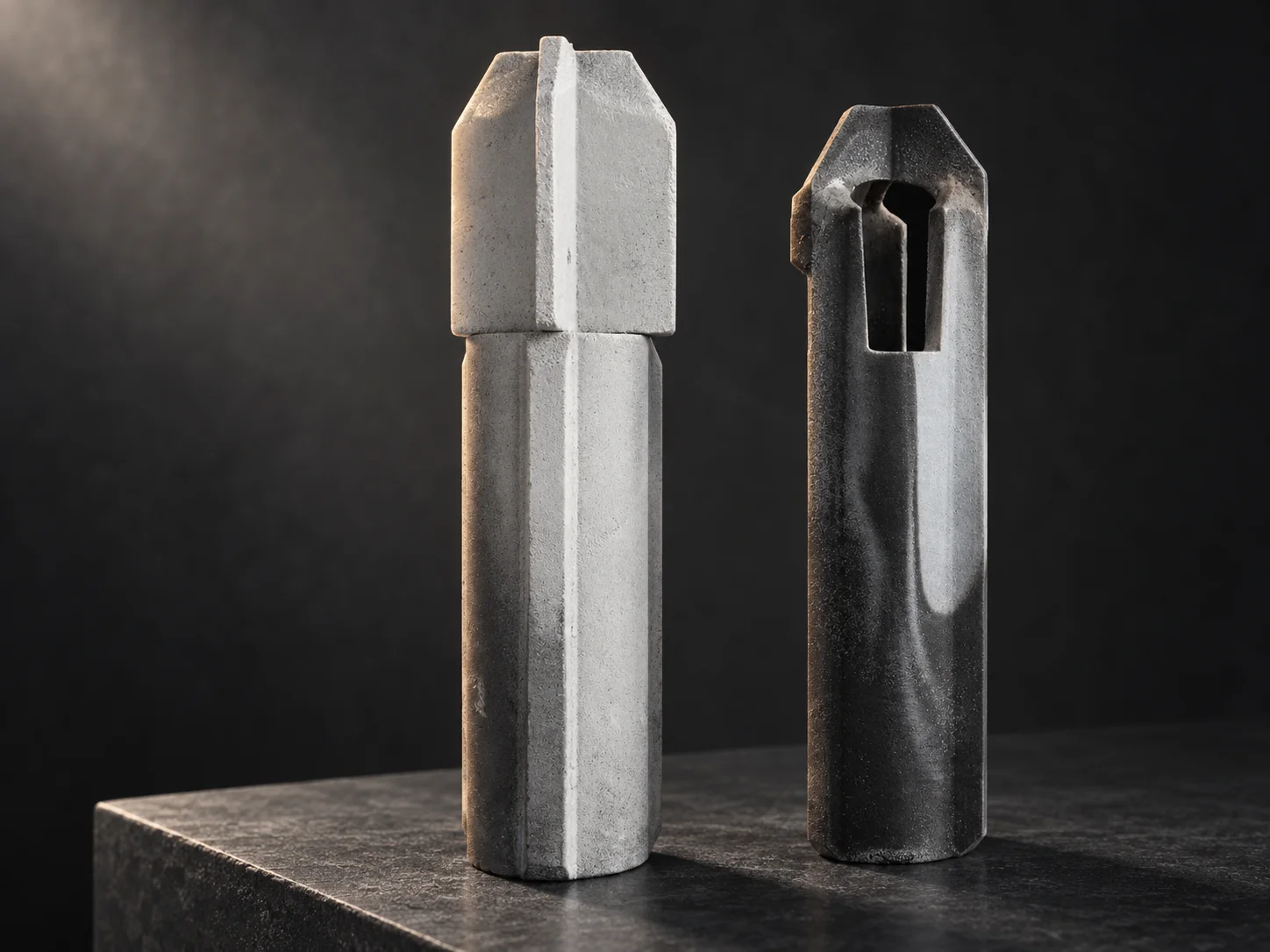
AI-assisted concept render, not a product photograph
3D PRODUCT VIEW
Turn the burner tube in 3D
An outline sketch of the burner tube. Drag to turn it and look at the octagonal body and the opening at its end.
Product details →Loading the 3D sketch…
- [email protected]
- Telephone
- +86 533 5375177
- Address
- Zibo, Shandong Province, China
- Office hours
- Mon–Sat 08:00–17:30 (GMT+8)
Dry vibratable castable
Developed by Guoshi on the basis of its low-cement castable for melting furnaces and launders. It is rammed or vibrated into place dry, with no water as a binder, so the curing period and the water-related cracking of a conventional castable are removed.
Loading the 3D sketch…
A section of a typical lining, not of Guoshi product shape. Layer thicknesses and anchoring follow the furnace design.
01 / SPECIFICATIONS
Typical properties and sizes.
| Installation | Dry ramming or vibration |
|---|---|
| Binder | No hydraulic binder; sinters in service |
| Curing | Not required; dry and bake after the former is removed |
| Max service temperature | To be supplied by Guoshi |
| Bulk density | To be supplied by Guoshi |
| Grades | To be supplied by Guoshi |
Also known as
- Dry vibratable castable for furnace linings
Names commonly used in the industry for this product and its same-material companion parts.
Range and formats
| Grade | Use | Installation | Max temp |
|---|---|---|---|
| GSJT-YS series | Melting furnace lining | Dry ramming | To be supplied |
| Launder grade | Launders and channels | Dry ramming | To be supplied |
Design preview: specifications, suitability and supply information require confirmation before publication. Not for quotation or product selection.
02 / MATERIAL & PROCESS
Dry vibratable castable
Installation is a tamping job: the material only has to be rammed evenly and densely against the shell. There is no mixing water, no hydraulic set, and no wet curing.
Once the former is removed the lining is dried and baked at moderate temperature and put into service. Because there is no water to drive off, cracking during bake-out and service is far less likely, and with it the risk of melt finding a path along a crack.
- 01Nothing to cureWith no water in the mix there is no seven-day wait and no bake-out schedule to get wrong.
- 02Fewer cracks, so fewer leaksCracks in a melting furnace lining are how metal gets out. Removing the water removes the commonest cause of them.
- 03Simple on siteUniform, dense ramming is the whole instruction.
03 / APPLICATIONS
Where it is used.
AAluminium melting furnace
BLaunder
- Guoshi product
- Insulation
- Steel shell
- Molten aluminium
Sketch of typical installations, not to scale and not of a particular customer’s plant. Guoshi parts are outlined in black and marked with a red leader.
Animated sketch of typical operating conditions, not of a particular customer’s plant. Equipment and sizes are not to scale.
- 01Aluminium melting and holding furnacesWorking lining against the melt.
- 02Launders and channelsLining of melt transfer channels.
- 03RepairLocal repair of melt-contact areas without wet curing.
ENQUIRY
Dry castable
Send the drawing, quantity or operating conditions you have, and Guoshi will reply by email.
Send an enquiry ↗